» Home 

Welcome to the Max-Planck-Institut für Kernphysik (MPIK, Max Planck Institute for Nuclear Physics) in Heidelberg, one of 83 institutes and research establishments of the  Max-Planck-Gesellschaft (Max Planck Society). The MPIK does experimental and theoretical basic research in the fields of Astroparticle Physics (crossroads of particle physics and astrophysics) and Quantum Dynamics (many-body dynamics of atoms and molecules).


Latest news


Enrico Fermi Prize awarded to Till Kirsten


The prestigious "Enrico Fermi" Prize has been awarded for 2017 to Gianpaolo Bellini, Veniamin Berezinsky and Till Arnulf Kirsten "for their outstanding contributions to neutrino physics and astrophysics", in particular:

  • to Gianpaolo BELLINI (Università di Milano and INFN-Sezione di Milano), "for the measurement of the solar neutrino spectrum, providing the evidence for nuclear hydrogen fusion in the Sun and for adiabatic neutrino flavour conversion in matter";
  • to Veniamin BEREZINSKY (Gran Sasso Science Institute-GSSI and INFN-LNGS, L’Aquila), "for his theoretical contributions to the cosmogenic production of ultra-high energy neutrinos, to high energy neutrino astronomy and to the solar neutrino problem";
  • to Till Arnulf KIRSTEN (Max-Planck Institut für Kernphysik, Heidelberg), "for the first observation of low energy solar electron neutrinos providing the first direct evidence of hydrogen fusion inside a star".

The "Enrico Fermi" Prize was created by the Italian Physical Society (SIF) in 2001 and it is yearly awarded to one or more members of the Society, who particularly honoured physics with their discoveries. The award ceremony will be part of the opening session of the 103rd National Congress of the Society in Trento on the 11th September 2017.

 SIF press release (Italian and English)

Abrupt motion sharpens x-ray pulses


Spectrally narrow x-ray pulses may be “sharpened” by purely mechanical means. This sounds surprisingly, but a team of theoretical and experimental physicists developed and realized such a method. It is based on fast motions, precisely synchronized with the pulses, of a target interacting with the x-ray light. Thereby, photons are redistributed within the x-ray pulse to the desired spectral region. (Science, 28 July 2017)

 Science Article (28 July 2017)

Molecular ions frozen under space-like conditions


The properties of cold negative molecular ions were investigated using OH anions in the Ultracold Storage Ring CSR at the Heidelberg MPI for Nuclear Physics. Under space-like conditions, the free radiative cooling of OH down to rotational ground state was monitored at an ambient temperature of less than 10 K. As a "thermometer", the rotational state-dependent photodetachment of the weakly bound electron was measured. The analysis of the experimental data provides new and fundamental knowledge about the interaction of the molecule with infrared radiation.

 Article at Physical Review Letters (14 July 2017)

Images of research at MPIK


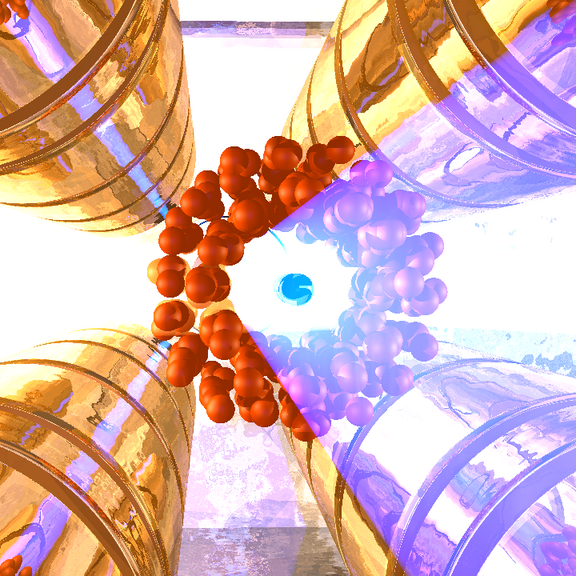
  • Artist‘s view of the reaction between protonated water and electrons in the CSR
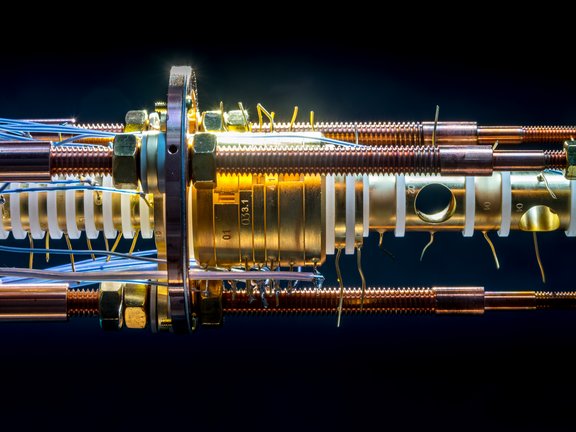
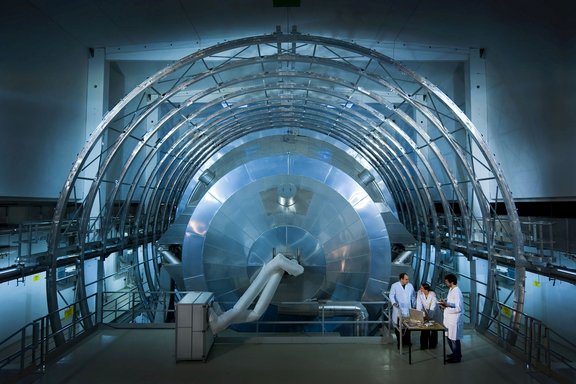
  • Copper strips distribute the cold to the experimental vacuum chambers of the CSR
  • The atomic mass of a bound electron is balanced by QED contributions in increasing order, playing the role of a precision mass set
  • Electrodes of a Penning trap
  • A liquid-nitrogen-cooled GaAs photocathode producing cold electron beams
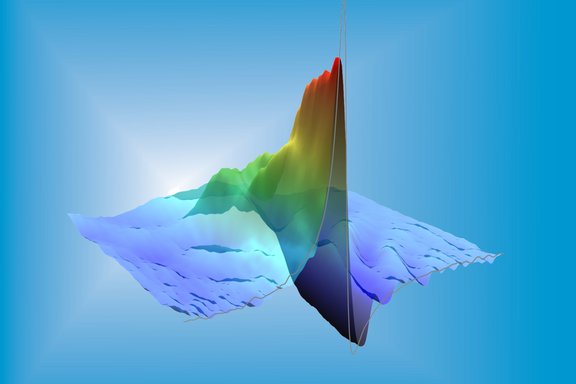
  • The emergence of a spectral line (Fano profile)
  • „Chirped mirror“ arrangement for ultrashort Laser pulses
  • Crystal of laser-cooled ions in a cryogenic Paul trap
  • A reaction microscope
  • Wave function for two electrons in doubly excited helium
  • Principle of the generation of an X-ray frequency comb by means of a laser-controlled gas
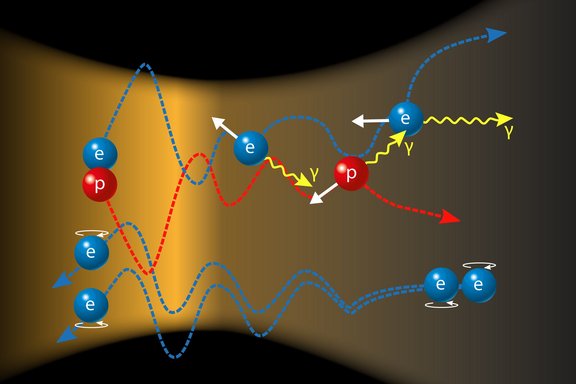
  • Schematic representation of interactions in extremely intense laser pulses: pair creation and spin-dependent trajectories
  • Illustration of laser control in atoms and nuclei
  • A laser-induced splitting gradient is used to store the complete frequency spectrum of a broadband pulse in a resonant medium
  • Tunnel ionization of a highly charged ion at relativistic laser intensities
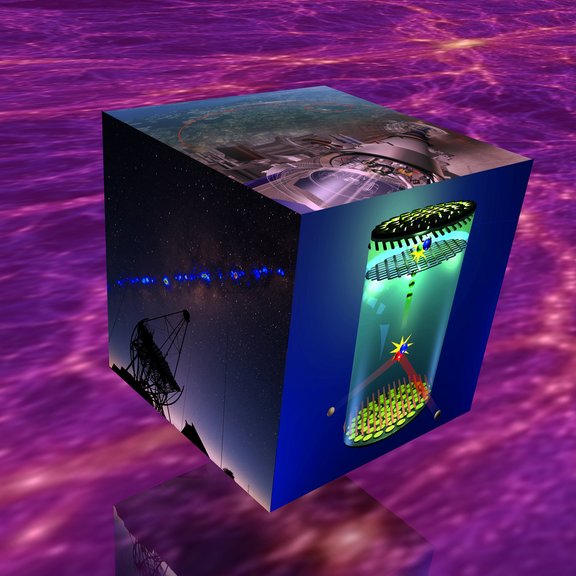
  • Cameras for CTA: CHEC for small telescopes in front of FlashCam for medium-sized telescopes
  • View of the full H.E.S.S. array with the four 12 m telescopes and the new 28 m H.E.S.S. II telescope
  • Image of a particle cascade viewed simultaneously by all five H.E.S.S. telescopes
  • A proton-lead collision observed by the LHCb detector
  • Predictions of the turbulent magnetic field excited ahead of a shock front
  • Integration of the acrylic vessels in the Double Chooz detector
  • Construction principle of the Nucifer detector
  • Elementary particles of the Standard Model and their hypothetical supersymmetric and seesaw partners
  • The GERDA detector strings with Nylon shielding and optical fibre
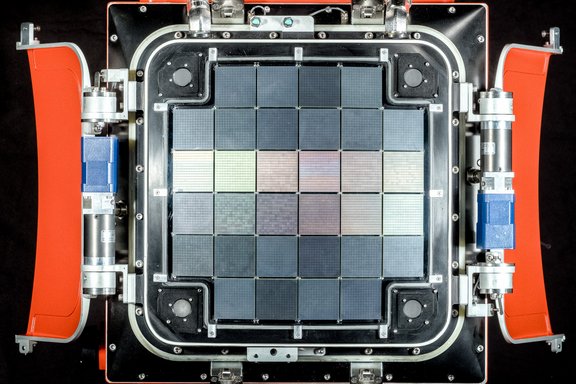
  • The upper photomultiplier array for the XENON1T experiment searching for Dark Matter
  • Annihilation tracks of antiprotons in an emulsion detector
  • Gold-plated mirror for a novel detector module in mid-infrared at the Cryogenic Trap for Fast ion beams (CTF).
  • Illustration of the rotational symmetry of an octahedron, used to construct models for fermion mixing
Max-Planck-Gesellschaft

28.07.17

Ruckartige Bewegung schärft Röntgenpulse

Spektral breite Röntgenpulse lassen sich rein mechanisch...


25.07.17

Molekülionen unter Weltraumbedingungen eingefroren

Laborastrophysik mit Anionen im ultrakalten Speicherring CSR


18.07.17

Das Proton präzise gewogen

Wie schwer ist ein Proton? Auf dem Weg zur möglichst...


15.07.17

Quantenmechanisches Tunneln braucht Zeit

Experiment bestätigt theoretische Vorhersage zur Zeitdauer...