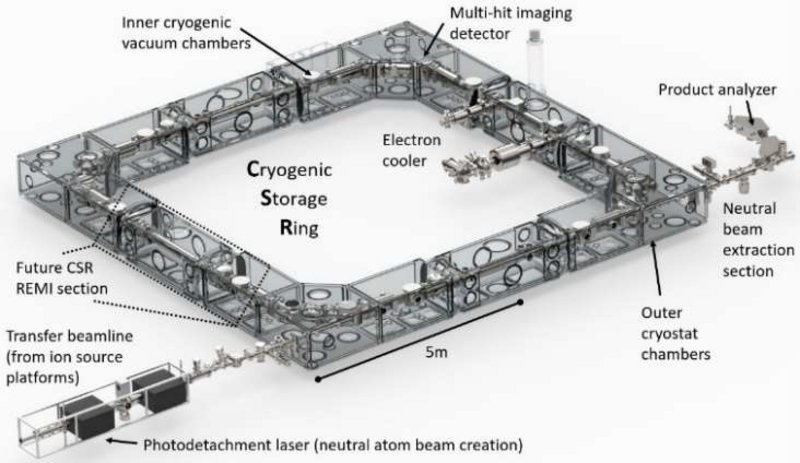
Our team is looking for Master students for various projects at the Cryogenic Storage Ring (CSR). The here proposed position includes measurements and related preparatory works for the electron-ion recombination studies with state-selected molecular ions.
You can learn about:
- Quantum dynamics of multielectron molecular systems
- Laboratory astrochemistry
- A pioneering, worldwide-unique research facility
- State of the art counting and imaging detectors
- Production of ultracold electron beams
- Analysis of large datasets, datamining
- Storage ring and accelerator physics
- Cryogenic and vacuum technology
- Labview/ROOT/python programming
Your tasks:
- Modeling internal relaxation of specific molecular ions in CSR (radiative cooling and inelastic electron-ion collisions)
- CSR measurements on recombination of specific molecular ion (e.g., HD+, N2H+, etc.)
- Data analysis
- Staying interested in and supporting other CSR projects
You can enjoy:
- Working in an international, gender-balanced team
- Support from electronics and precision mechanics workshops and in-house engineering design office
- Nature-surrounded working place with a good bus connection
Interested? We will be happy to hear from you!
More Master positions are available at CSR, do not hesitate to ask!
Physics background:
The neutralization of molecular ion by the capture of a free electron is usually accompanied by an excess of energy leading to the breakup of the resulting neutral molecule. This dissociative recombination (DR) reaction is a fundamental process that often governs chemistry in cold plasmas such as interstellar clouds. The complexity of electron capture, interference between dissociation pathways, and the strong structural change in DR make the process difficult to calculate theoretically. Experimental studies are also challenging due to the strong dependence of the DR process on the rotational excitation of the molecular ions in typical room temperature experiments. The CSR is a worldwide unique setup for studying DR in a cryogenic environment where the ions radiatively deexcite to their ro-vibrational ground state. Studies with such state-defined ions are then of high value in astrochemical models as well as for benchmarking quantum dynamics theories.
Contacts:
Dr. Oldrich Novotny: Phone +49 6221 516-547 | MPIK
PD Dr. Holger Kreckel: Phone +49 6221 516-517 | MPIK
Prof. Dr. Klaus Blaum: Phone +49 6221 516-851 | Secretariat
Selected CSR publications:
Znotins, A. et al., Nat. Commun. 16, 7738 (2025)
Kálosi, Á. et al., Phys. Rev. A. 110, 022816 (2024)
Kálosi, Á. et al., Astrophys. J. Lett. 955, L26 (2023)
Kálosi, Á. et al., Phys. Rev. Lett. 128, 183402 (2022)
Grieser, M. et al., Rev. Sci. Instr. 93, 063302 (2022)
Müll, D. et al., Phys. Rev. A 104, 032811 (2021)
Novotný, O. et al., Science, 365, 676 (2019)
Kreckel, H. et al., Philos. Trans. Royal Soc. A 377, 0412 (2019)
Meyer, C. et al., Phys. Rev. Lett. 119, 023202 (2017)
O’Connor, A. P. et al., Phys. Rev. Lett 116, 113002 (2016)
Von Hahn, R. et al., Rev. Sci. Instr. 87, 063115 (2016)
Our team is looking for Master students for various projects at the Cryogenic Storage Ring (CSR). The here proposed position includes Development of a method for online detector signal analysis using machine learning.
You can learn about:
- Modern techniques for detector signal processing
- Advanced detector readout and data acquisition systems
- Analysis of large datasets and datamining
- Fundamentals of storage ring and accelerator physics
- Labview/ROOT/python programming
- Working at a pioneering, world-unique research facility
Your tasks:
- Develop signal-processing methods for existing Micro Channel Plate (MCP) and microcalorimeter array (MOCCA) detectors
- Apply machine-learning techniques to resolve signal overlaps (pile-up) and suppress noise
- Test and implement these methods using existing datasets and/or in live measurements
- Contribute to and collaborate on other CSR-related projects
You can enjoy:
- A collaborative, international, and gender-balanced research environment
- Access to dedicated electronics and precision mechanics workshops, as well as an in-house engineering design office
- A unique workplace surrounded by nature, with convenient public transport access
Interested?
We would be happy to hear from you!
Additional Bachelor’s and Master’s projects are available at CSR—feel free to reach out.
Physics background:
At CSR, we investigate fundamental molecular reactions under well-controlled conditions. Molecular ions are stored in a cryogenic environment for extended periods, allowing them to relax into their ro-vibrational ground state. These ions can then interact with, for example, an electron beam, enabling precise studies of electron–ion recombination processes.
Following recombination, the resulting neutral systems often fragment. These fragments are detected by specialized cryogenic detectors that provide not only event counting but also detailed spatial and temporal information. This 3D imaging approach reveals key properties of the reaction dynamics, including excitation states and even the quantum orbitals involved in electron capture.
Achieving this level of insight requires resolving MCP detector signals on nanosecond timescales. Machine learning plays a crucial role here by:
- Separating overlapping detector signals (pile-up)
- Extracting precise timing information
- Distinguishing signals from noise
For the newly developed MOCCA microcalorimeter detector, signals also encode positional information via their shape (e.g., decay-time). Machine-learning methods enable the extraction of impact energy and position even in complex, noisy environments.
These developments will significantly expand the range and precision of experiments at CSR, contributing to a deeper understanding of molecular reaction dynamics and supporting advanced theoretical models.
Contacts:
Dr. Oldřich Novotný : Phone +49 6221 516-547 | MPIK
PD Dr. Holger Kreckel: Phone +49 6221 516-517 | MPIK
Prof. Dr. Klaus Blaum: Phone +49 6221 516-851 | Sekretariat
Selected CSR publications:
Znotins, A. et al., Nat. Commun. 16, 7738 (2025)
Grussie F. et al., Phys. Rev. Lett. 132, 243001 (2024)
Kálosi, Á. et al., Astrophys. J. Lett. 955, L26 (2023)
Kálosi, Á. et al., Phys. Rev. Lett. 128, 183402 (2022)
Grieser, M. et al., Rev. Sci. Instr. 93, 063302 (2022)
Müll, D. et al., Phys. Rev. A 104, 032811 (2021)
Novotný, O. et al., Science, 365, 676 (2019)
Kreckel, H. et al., Philos. Trans. Royal Soc. A 377, 0412 (2019)
Meyer, C. et al., Phys. Rev. Lett. 119, 023202 (2017)
Gamer L. et al., J. Low T. Phys. 184, 839 (2016)
O’Connor, A. P. et al., Phys. Rev. Lett 116, 113002 (2016)
Von Hahn, R. et al., Rev. Sci. Instr. 87, 063115 (2016)
Our team is looking for Bachelor students for various projects at the Cryogenic Storage Ring (CSR). The here proposed position includes Development of a method for online detector signal analysis using machine learning.
You can learn about:
- Modern techniques for detector signal processing
- Advanced detector readout and data acquisition systems
- Analysis of large datasets and datamining
- Fundamentals of storage ring and accelerator physics
- Labview/ROOT/python programming
- Working at a pioneering, world-unique research facility
Your tasks:
- Develop signal-processing methods for existing Micro Channel Plate (MCP) and microcalorimeter array (MOCCA) detectors
- Apply machine-learning techniques to resolve signal overlaps (pile-up) and suppress noise
- Test and implement these methods using existing datasets and/or in live measurements
- Contribute to and collaborate on other CSR-related projects
You can enjoy:
- A collaborative, international, and gender-balanced research environment
- Access to dedicated electronics and precision mechanics workshops, as well as an in-house engineering design office
- A unique workplace surrounded by nature, with convenient public transport access
Interested?
We would be happy to hear from you!
Additional Bachelor’s and Master’s projects are available at CSR—feel free to reach out.
Physics background:
At CSR, we investigate fundamental molecular reactions under well-controlled conditions. Molecular ions are stored in a cryogenic environment for extended periods, allowing them to relax into their ro-vibrational ground state. These ions can then interact with, for example, an electron beam, enabling precise studies of electron–ion recombination processes.
Following recombination, the resulting neutral systems often fragment. These fragments are detected by specialized cryogenic detectors that provide not only event counting but also detailed spatial and temporal information. This 3D imaging approach reveals key properties of the reaction dynamics, including excitation states and even the quantum orbitals involved in electron capture.
Achieving this level of insight requires resolving MCP detector signals on nanosecond timescales. Machine learning plays a crucial role here by:
- Separating overlapping detector signals (pile-up)
- Extracting precise timing information
- Distinguishing signals from noise
For the newly developed MOCCA microcalorimeter detector, signals also encode positional information via their shape (e.g., decay-time). Machine-learning methods enable the extraction of impact energy and position even in complex, noisy environments.
These developments will significantly expand the range and precision of experiments at CSR, contributing to a deeper understanding of molecular reaction dynamics and supporting advanced theoretical models.
Contacts:
Dr. Oldřich Novotný : Phone +49 6221 516-547 | MPIK
PD Dr. Holger Kreckel: Phone +49 6221 516-517 | MPIK
Prof. Dr. Klaus Blaum: Phone +49 6221 516-851 | Sekretariat
Selected CSR publications:
Znotins, A. et al., Nat. Commun. 16, 7738 (2025)
Grussie F. et al., Phys. Rev. Lett. 132, 243001 (2024)
Kálosi, Á. et al., Astrophys. J. Lett. 955, L26 (2023)
Kálosi, Á. et al., Phys. Rev. Lett. 128, 183402 (2022)
Grieser, M. et al., Rev. Sci. Instr. 93, 063302 (2022)
Müll, D. et al., Phys. Rev. A 104, 032811 (2021)
Novotný, O. et al., Science, 365, 676 (2019)
Kreckel, H. et al., Philos. Trans. Royal Soc. A 377, 0412 (2019)
Meyer, C. et al., Phys. Rev. Lett. 119, 023202 (2017)
Gamer L. et al., J. Low T. Phys. 184, 839 (2016)
O’Connor, A. P. et al., Phys. Rev. Lett 116, 113002 (2016)
Von Hahn, R. et al., Rev. Sci. Instr. 87, 063115 (2016)