TRIGA-TRAP Project
Introduction
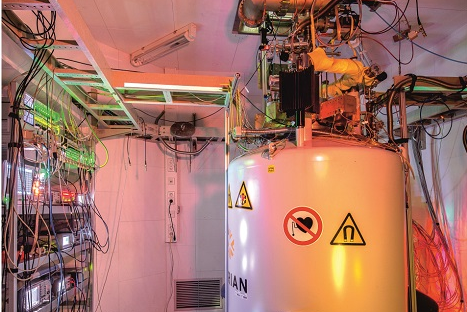
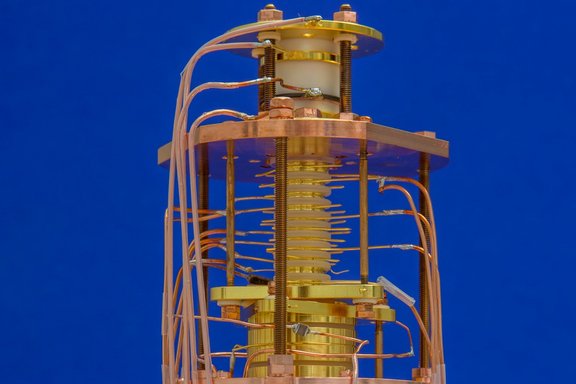
TRIGA-TRAP is a newly developed double-Penning trap mass spectrometer, especially designed for experiments with single singly charged ions [1].
Concerning detection techniques, the system features the commonly used destructive time-of-flight resonance method as well as the narrow-band non-destructive FT-ICR technique as described here. Within the TRIGA-TRAP project we installed for the very first time a Penning trap at a nuclear research reactor in order to have access to neutron-rich fission products. Moreover, samples of stable nuclides as well as of heavy elements above uranium are available for off-line measurements. Masses of these nuclides are of high importance among others for reliable nucleosynthesis calculations in nuclear astrophysics and for investigations of nuclear structure.
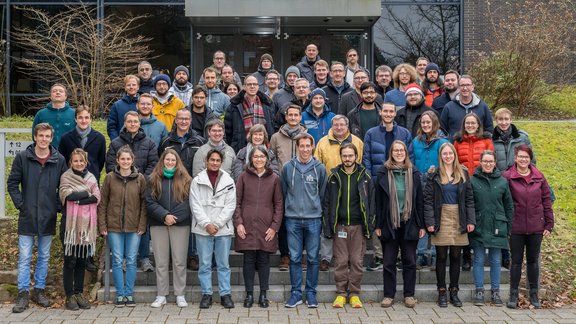
The Penning trap mass spectrometer is part of the TRIGA-SPEC [1] spectroscopy project
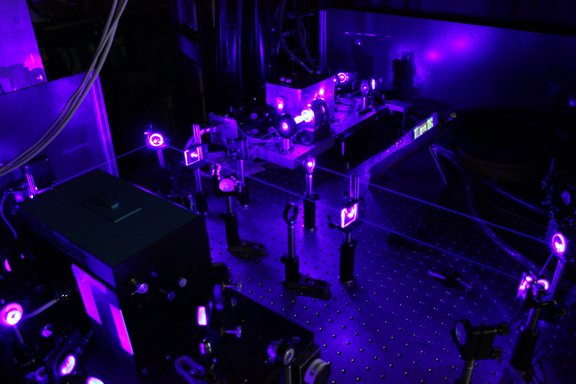
(see photo on the left), which also includes the collinear laser spectroscopy setup
TRIGA-LASER
. The mass spectrometer is comissioned and tests to determine systematic
uncertainties as well as first off-line mass measurements have been performed [2].
Currently an ECR and a high temperature surface ion source [HELIOS] are commissioned
which in connection with a gas jet transport system will enable access to
fission products. For this purpose a 30 kV high voltage platform has been installed.
The mass separation after the ion source is carried out by a 90° dipole magnet with
a resolution of about 500. In the near future the cooler and buncher COLETTE [3],
which has been transferred from CERN to TRIGA-SPEC, will be installed in order to
prepare cooled ion bunches for the connected experiments.
The research within the framework of the TRIGA-TRAP project has close affiliations
with the goals of the Extreme Matter Institute (EMMI)
at GSI/Darmstadt
.
The institute was created by the Helmholtz Alliance "Extremes of Density and
Temperature: Cosmic Matter in the Laboratory". This Alliance connects GSI with
7 national partners (among them the Max Planck Institute for Nuclear Physics
at Heidelberg) as well as 4 international partners. With EMMI Europe will get
a unique infrastructure for interdisciplinary investigations of matter under
extreme conditions.
Applications for mass measurements with TRIGA-TRAP
The chemical composition of our universe has many surprising features: Why is iron so much more abundant than heavier elements such as gold? Why are there heavy elements at all and how did they come into existence? The properties of atomic nuclei, especially their masses, play a crucial role in these fundamental questions at the interface of nuclear and astrophysics. TRIGA-TRAP aims for mass measurements on neutron rich nuclei located in the least explored region of the chart of nuclides (see Figure below) that are important for the rapid neutron capture process. In addition, heavy nuclides above uranium can be studied off-line. The high- precision mass value yields the total nuclear binding energy of the nuclei relevant for nuclear structure studies since the binding energy is the result of the forces present in a nucleus.
References
| [1] |
J. Ketelaer et al., Nucl. Instrum. Meth. A 594 (2008) 162 |
| [2] |
J. Ketelaer et al., Eur. Phys. J. D 58 (2010) 47 |
| [3] |
D. Lunney et al., Nucl. Instrum. Meth. A 598 (2009) 379 |
| [4] |
J. J. Cowan et al., Phys. Today 57 (2004) 47 |