PENTATRAP Project
Motivation
The new Penning trap project PENTATRAP for high-precision mass measurements on highly charged stable ions related to tests of fundamental symmetries and constants is presently under construction at the MPIK. PENTATRAP aims for a relative precision of the mass measurement of δm/m <= 10-11. For example, it will open a way to an experimental determination of the upper limit of the neutrino mass in the electron capture sector with an accuracy of ~1eV [1]. Another example is the test of quantum electrodynamics in the little explored regime of extreme fields.
Experimental Setup
The PENTATRAP experiment will be attached to the Heidelberg EBIT [2] (see Fig.1) or later to the HITRAP project at GSI [3], where the ions of interest will be produced.
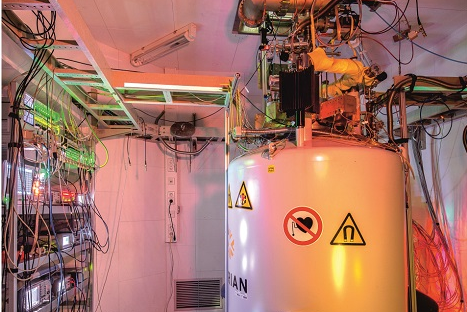
Then the highly charged ions will be guided by ion optical elements into the Penning trap setup, which is placed in a superconducting magnet of 7 T (see Fig. 2).
The trap-tower as well as the detection electronics will be surrounded by a 4 K environment. A translation and tilt stage enables the online alignment of the Penning traps towards the magnetic field lines. Furthermore, to ensure stable and well-controlled environmental conditions, the setup will be placed in a room, in which the temperature fluctuations will be reduced below 0.1 K. To minimize disturbing effects due to vibration, the magnet is supported by anti-vibration pneumatic pads. Moreover, a stabilization of the helium level and the gas pressure in the liquid helium dewar of the magnet will be implemented. Advanced feedback control of the magnetic field via flux-gate magnetometry will be used to correct fluctuations in the vertical component of the earth magnetic field.
Penning trap system
The mass determination of an ion in a Penning trap is done by measuring its free
cyclotron frequency
νc = 1/(2π) ⋅ qB/m ,
where q/m is the charge-to-mass ratio of the ion and B the magnetic field. Only relative
mass measurements, where the magnetic field is calibrated via a mass comparison are
carried out to achieve highest precision. Thus, the frequency ratio between an ion of
interest (IOI) and a reference ion (RI) has to be alternately measured. Therefore,
undetected B-field fluctuations are one of the main uncertainties limiting the precision
of high-precision mass measurements.
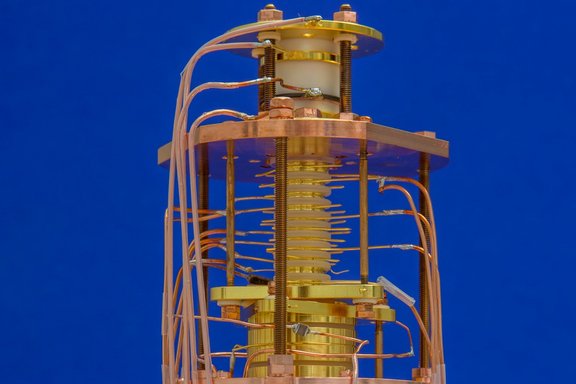
At PENTATRAP a novel trap system (see Fig. 3 and 4) consisting of five independent trapping regions will guarantee high-precision frequency measurements. All traps are cylindrical five-pole Penning traps [4].
The inner traps will be used for high-precision frequency measurements. Applying the measurement scheme shown in Fig. 5, a fast (but adiabatic) exchange during the measurement cycle of the two ion species (IOI and RI) is possible, without any loss of time due to ion preparation processes. At the bottom as well as at the top of the tower two traps serve as so called "monitor traps" for the observation of the magnetic field fluctuations via the detection of the cyclotron frequency of a permanently stored ion. Thus, a magnetic field correction between the two measurements of the IOI and the RI can be carried out, to reduce the uncertainty in the mass determination additionally. With a set of five Penning traps a variety of other measurement schemes is possible.
Ion detection
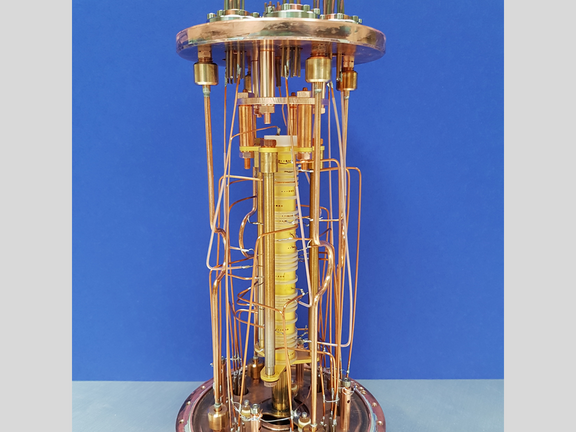
The frequency determination will be carried out with the Fourier-transform ion-cyclotron resonance detection technique. Here, the very tiny image current (~fA) induced by the ion motion in the trap electrodes is non-destructively detected. To detect these very tiny current, it is necessary to ensure a sufficient signal-to-noise ratio. To this end, the electrodes are connected to tuned circuits, which consist of a high-Q inductor (example see Fig. 6) followed by a high-impedance amplifier. These circuits are placed close to the trap in the 4 K environment, since thermal noise is reduced and low-loss superconducting circuits can be applied. Typical values are a Q-factor in the range of 104 and a voltage noise of the amplifiers below 1 nV/(Hz)^1/2.
References
| [1] | K. Blaum, Yu. Novikov, G. Werth, Contemp. Phys. 51(2), 149 (2010) |
| [2] | J. Crespo López-Urrutia, et al., Rev. Sci. Instrum.75(5), 1560 (2004) |
| [3] | H.-J. Kluge et al., Dav. Quantum Chem. 53 (2008) 83. |
| [4] | G. Gabrielse, L. Haarsma, S. L. Rolston, Int. J. Mass Spectrom. Ion Process. 88(2-3), 319 (1989) |
Comments
The research within the framework of the PENTATRAP project has close affiliation with
the goals of the Extreme Matter Institute (EMMI)
at GSI/Darmstadt
.
The institute was created by the Helmholtz Alliance "Extremes of Density and Temperature: Cosmic Matter in the Laboratory".
This Alliance connects GSI with 7 national partners (among them the Max Planck Institute for Nuclear Physics at Heidelberg) as well as 4 international partners.
With EMMI Europe will get a unique infrastructure for interdisciplinary investigations of matter under extreme conditions.