|
The group experimentally explores fundamental few-particle quantum systems in atoms, molecules, molecular and highly-charged ions as well as in cold and ultra-cold ensembles. Members: Joachim Ullrich, José Ramon Crespo López-Urrutia, Alexander Dorn, Daniel Fischer, Selim Jochim, Robert Moshammer, Thomas Pfeifer, Claus Dieter Schröter, Alexander Voitkiv, Carsten Welsch, Christian Beilmann, Peter Caradonna, Sascha Epp, Natalia Ferreira, Lutz Foucar, James Harries, Siva Rama Krishnan, Moritz Kurka, Aaron LaForge, Thomas Lompe, Bennaceur Najjari, Marco Panniello, Xueguang Ren, Artem Rudenko, Arne Senftleben, Oscar Versolato, Shaofeng Zhang, Thomas Baumann, Sven Bernitt, Rebecca Boll, Nicolas Camus, Lutz Fechner, Andreas Fischer, Johannes Goullon, Renate Hubele, Andreas Kaldun, Kristina Meyer, Christian Ott, Thomas Pflüger, Philipp Raith, Helga Rietz, Jan Rudolph, Michael Schönwald, Katharina Schneider, Kirsten Schnorr, Michael Schuricke, Maria Schwarz, Stefan Sellner, Friedhelm Serwane, Alexander Sperl, René Steinbrügge, Veerle Sterken, Sara Tegami, André Wenz, Alexander Windberger, Gerhard Zürn, Johanna Bohn, Philipp Cörlin, Martin Laux, Martin Ries, Rima Schüssler, Lisa Schmöger, Andrea Bergschneider, Matteo Ceci, Sebastian Georgi, Vincent Klinkhamer, Andreas Krupp, Mathias Neidig, Marten Prieß, Sören Bieling, Christoph Bogda, Alexander Broska, Lisa Buchauer, Stark Julian, Julian Stark, Veit Stooß, Thomas Busch, Christian Kaiser, Bernd Knape, Helga Krieger, Norbert Müller, Claudia Ries, Michael Holzscheiter, Alban Kellerbauer, Hannes Lindenblatt, Bernd Martin, Paul Mokler, Alexander Papash, Eva Peper, Georg Schmid, Michael Schulz, Zhangyong Song, Juliana Stachurska, Difa Ye,
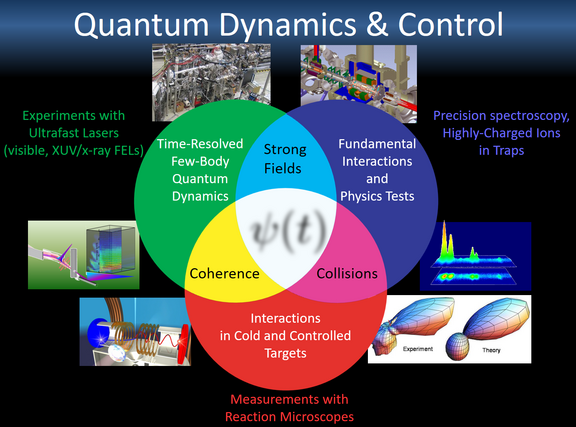
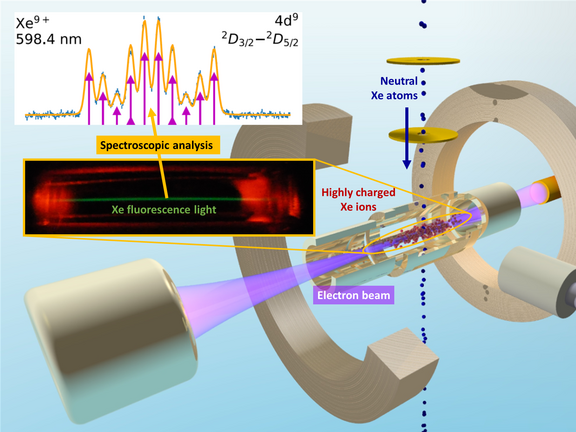
- Time independent structure is investigated by precision spectroscopy of highly-charged (radioactive) ions up to He-like systems for all elements, testing Quantum Electrodynamics (QED), relativistic, nuclear and few-electron contributions at MPIK, GSI, and TRIUMF. Photon interactions with highly charged ions are studied at BESSY and at FLASH.
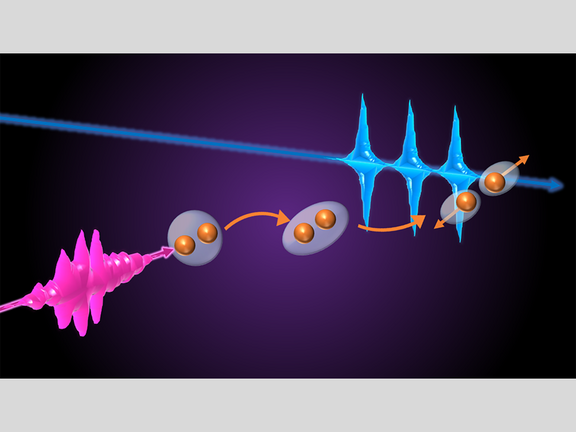
- Time dependent dynamics in atomic, molecular, cluster or ion reactions are explored on the femto- to attosecond time scale using ultra-fast lasers at the MPIK, the Max-Born Institute (MBI), the Max-Planck Institut for Quantum Optics (MPQ) and the Free Electron Lasers at Desy (FLASH) and SPring8 (SCSS). Atto- to zepto-second times are accessible in interactions with fast electrons or positrons (NEPOMUC), with highly-charged ions at MPIK or, for up to relativistic energies and antiprotons at the GSI and CERN.
-
Time dependent structure (e.g. electronic or position of atoms in molecules) is accessed via ultra-fast X-ray photon diffraction within the Max Planck Advanced Study Group (ASG) at the Center for Free Electron Laser Science (CFEL) in Hamburg exploiting the 4th generation, Free Electron Laser X-ray source in Stanford (LCLS).
- Fundamental interactions, gravity of antimatter are studied in anti-hydrogen at CERN and the GSI.
|
Recent picture:
The ultracold quantum gases group with their apparatus
|