www.mpi-hd.mpg.de

Theory Division

Theoretical Quantum Dynamics and Quantum Electrodynamics

 

www.mpg.de


Diploma/Master student – Atoms in attosecond and x-ray free-electron laser light
The student will learn the state of the art of light-matter interaction, x-ray free electron lasers, strong-field physics, attosecond physics, and present-day challenges in theoretical atomic, molecular, and optical physics. He/she will carry out analytic derivations, program Mathematica or fortran95, and analyze numerical results. The project shall be presented orally and in writing.

Project one: Manipulation of the high harmonic generation process with x rays


The ultrashort time-resolution of the novel attosecond (10-18 s) light sources offers totally new opportunities for studying the time dependence of physical problems. This new light enables us to “watch” electrons move on their natural time scale.

The combined interaction of xuv light from an attosecond light source and the light from an optical laser, a two-color problem, represents a fundamental problem. The combination of the two so different colors is highly beneficial because the two different wavelengths address two different physical situations; namely, xuv light interacts almost exclusively with inner-shell electrons while optical light interacts almost exclusively with valence, excited, and continuum electrons. In two-color problems, the laser is used to prepare, manipulate, or probe the sample before, during, or after, respectively, xuv exposure. Prospects for two-color physics are, therefore, fascinating.

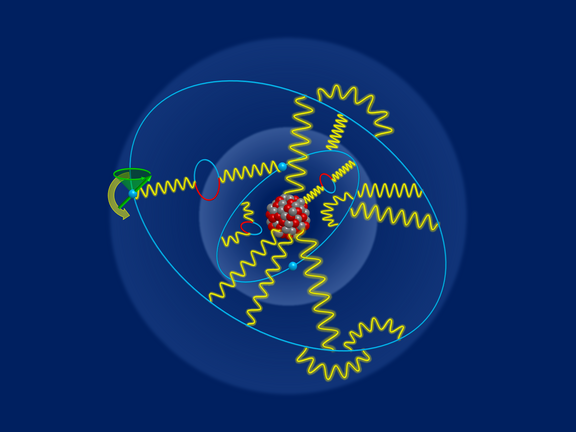
High harmonic generation (HHG) is a process that occurs when atoms and molecules are placed in the field of a laser that is sufficiently intense to ionize them. HHG is frequently described in terms of the three-step model. First, the system is valence ionized; second, the liberated electron propagates freely in the electric field of the laser; third, the direction of the laser field reverses and the electron is driven back to the ion and eventually recombines with it emitting HHG radiation.

The escape time of the liberated valence electron from the ion is roughly 1 fs for the typical 800 nm laser light. During this time, one can manipulate the ion such that the returning electron sees an altered ion. Then, the emitted HHG radiation bears the signature of the change. Perfectly suited for this modification during the propagation step is resonant x-ray excitation of an inner-shell electron to the valence shell to fill the formerly created valence hole. The recombination of the returning electron with the core hole leads to a large increase of the energy of the emitted HHG light as the energy from the x-ray excitation is added to the unmodified HHG spectrum.

In addition to extending the interesting properties of HHG light from the xuv to the x-ray domain, the rate of x-ray absorption represents a probe of the transient ion. As HHG is a key technique in many areas of atomic, molecular, and optical physics, the increase in wavelength can be beneficial for various further settings like attosecond pulse generation, two-color pump-probe experiments (optical plus x rays), and imaging of inner-shell orbitals.

Project two: Ion yields and multiple core hole formation and decay


Atoms and molecules in x-ray light of conventional x-ray sources like synchrotrons absorb at most a single x-ray photon during exposure. The reason for the one-photon character of the interaction is the comparatively low x-ray intensities available until today. The situation has changed with the advent of three hard x-ray free electron lasers (FELs) that have been built. In Stanford, California, USA, the Linac Coherent Light Source (LCLS) was commissioned and has been serving users since October 2009. In Harima Science Garden City, Hyogo, Japan, the SPring-8 Compact SASE Source (SCSS) is being built; user operations are anticipated to begin in 2011. Finally, in Hamburg, Germany the European X-Ray Laser Project (XFEL) will commence serving the x-ray community in the year 2015. Experiments at FELs rely heavily on theory for their interpretation. Conversely, theory can make unexpected predictions that lead to experimental discoveries.

We would like to investigate the interaction of a molecule with intense x rays. Ion yields are a measure for the probability to find atomic and molecular fragments in a specific charge state with a certain number of core holes after irradiation with x rays. They are a meeting point of experiment and theory. For their prediction, we need to describe the time evolution of the absorption of x rays and the induced decay processes. For x-ray irradiation durations of only a few femtoseconds, nuclear dynamics (particularly due to Coulomb explosion of the charged fragments) does not play a role. However, for longer pulses the expansion dynamics needs to be accounted for.

The work will help interpreting the ion yield spectra of experiments. Specifically, atoms and molecules in intense x-ray FEL light of high enough photon energy can be doubly core ionized by sequentially absorbing two x-ray photons. We would like to pursue an in-depth investigation of the formation of double core holes (DCHs) and their electronic decay in molecules. What can we learn from DCH spectroscopy about molecules? The formation of DCHs gives us detailed information about energies of a neutral molecule and molecular ions; it was found to be more sensitive than single core hole spectroscopy.
The research project will be carried out at the Max Planck Institute for Nuclear Physics, Saupfercheckweg 1, 69117 Heidelberg, Germany. Please send your application by email to Equal opportunity is a cornerstone policy of the Max Planck Society, and women as well as disabled people are particularly encouraged to apply. This position is open and applicants are invited as of now.


Group Homepage Group Homepage