www.mpg.de

Theory Division

Theoretical Quantum Dynamics and Quantum Electrodynamics

www.mpi-hd.mpg.de

High-Energy Quantum Electrodynamics


Quantum electrodynamics (QED) is the best tested theory we have and its predictions have been experimentally confirmed with high precision. However, there is still an area of QED that has not yet been fully investigated both theoretically and experimentally: QED in intense background electromagnetic fields (see the review V. I. Ritus, J. Russ. Laser Res. 6, 497 (1985).).

The typical field amplitude scale is determined here by the so-called "critical" electric and magnetic fields: Ecr=1.3 × 10¹⁶ V/cm and Bcr=4.4 × 10¹³ G that correspond to a laser intensity of Icr=2.3 × 1029 W/cm2. In the presence of such strong fields fascinating phenomena take place and become manifest. Among them we quote spontaneous electron-positron pair production from vacuum, harmonic generation in vacuum and so on. All these phenomena have their ultimate origin in the structure of the vacuum, as predicted by quantum field theory and, in particular, by QED. The vacuum is no more an empty space-time region as in classical physics, but a region of space-time where particle-antiparticle pairs are continuously created and annihilated (vacuum fluctuations, Fig. 1).

Fig. 1. Cartoon view of the quantum vacuum where particle-antiparticle pairs are continuously created and annihilated.

In this context strong laser fields that are already or soon available represent a unique tool to investigate experimentally the predictions of QED. Numerous Petawatt laser facilities are under construction aiming at laser intensities of the order of 1023 W/cm2. Moreover, intensities of the order of 1025-1026 W/cm2 are envisaged at the Extreme Light Infrastructure (ELI) and at the High Power laser Energy Research (HiPER).

We consider three main aspects of QED in the presence of intense laser fields: the nonlinear dielectric properties of the quantum vacuum, high-energy QED processes in intense laser fields and radiative corrections in intense laser fields. Concerning the first aspect, QED predicts that the presence of virtual electron-positron pairs in the vacuum modifies its dielectric properties. In order to reveal these properties strong electromagnetic fields are needed of the order of the critical fields that drive the vacuum fluctuations. Concerning the second aspect, we study QED processes where high-energy electron or photon beams collide with intense laser fields. The corresponding cross-sections show a very complex dependence on the laser field parameters giving the possibility of testing QED with high accuracy. Finally, in the presence of such intense fields, radiative corrections due to the interaction of the electrons with their own electromagnetic field become important and have to be taken into account. We are considering this problem both from a classical and a quantum point of view.

People:

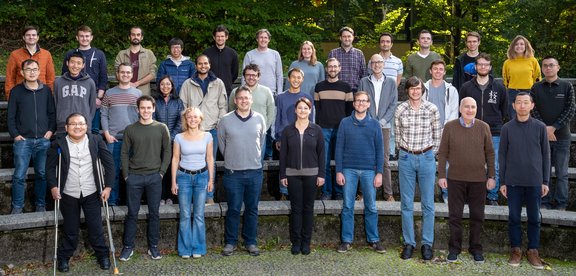
May 2011, from left to right: front row: Ashutosh Sharma, Antonino Di Piazza, Norman Neitz; back row: Omri Har-Shemesh, Ben King, Felix Mackenroth, Sebastian Meuren

Open positions:

  • No available positions at moment

Recent and Actual Projects


Determining the carrier-envelope phase of intense few-cycle laser pulses

An important ingredient of the generation of ultrastrong laser pulses is the compression of the laser energy to shorter and shorter time scales. Themporal compression down to two laser cycles or even to one single laser cycle has already been achieved experimentally in different frequency ranges. In this few-cycle regime the response of atoms and molecules to a laser pulse becomes dependent on the carrier envelope phase (CEP) of the driving field, i. e. the phase difference between the carrier wave and the envelope function. Experimental determination of the CEP, however, has been possible so far only for laser intensities up to 1014-1015 W/cm2. Presently available peak laser intensities are of the order of 1022 W/cm2 and ultrashort laser pulses of such high intensities are envisaged (see for example the PFS project under development in Garching, Germany). Therefore, it is highly desirable to have a procedure to determine the CEP of short laser pulses also when their intensity largely outruns the realm of applicability of the traditional determination schemes. We have theoretically described a method of determining in principle the CEP of a strong (intensity larger than 1020 W/cm2) short laser pulse by employing multiphoton Compton scattering [1]. The method exploits the fact that an ultrarelativistic electron emits radiation almost exclusively in a narrow cone along its instantaneous velocity. Thus, determining the electron's angular emission pattern from a scattering event by an ultra-short laser pulse provides knowledge about the electron's trajectory and in turn about the CEP of the driving fuild (see Fig. 1).

Fig. 1. Typical multiphoton Compton scattering spectra for two different physical situations: in parts a) and b) recoil effects in the photon spectra are negligible, while in parts b) and c) they are important and taken into account. In both cases the angular width of the emission region is compared with analytical predictions for two different values of the CEP (white horizontal lines): -&pi/10 and -&pi/5 in parts a) and b), respectively, and 0 and &pi/4 in parts c) and d), respectively. Figure from Ref. [1], copyright of the American Physical Society.


[1] F. Mackenroth, A. Di Piazza and C. H. Keitel, Phys. Rev. Lett. 105, 063903 (2010).

A matterless double-slit

When light passes through a double-slit under certain conditions, it creates a series of bright and dark fringes on a screen some distance away. This is due to intereference between the signals at each slit and demonstrates the wave-like nature of light. If one pictures light as discrete photons and attempts to measure which slit the light chose, the pattern will disappear, demonstrating the particle-like nature of light. The double-slit experiment has been central to the development and understanding of quantum mechanics and the wave-particle duality of nature. So far, all the experimental double-slit schemes proposed and realized have involved matter. However, quantum electrodynamics predicts that electromagnetic fields can also interact in vacuum through charged virtual particles (vacuum fluctuations). By exploiting this pure quantum interaction we have envisaged a matterless double-slit scenario consisting only of light [2]. In the proposed scenario two separated, parallel Gaussian laser beams form the "slits" that are probed by a third Gaussian laser beam which is diffracted to generate an interference pattern entirely from light (see Fig. 1, where the strong beams come from the right and the probe beam is counterpropagating to them). In Fig. 1 a typical interference pattern is shown, where typical alternating maxima and minima are visible. In [2] the possibility of observing this effect experimentally is also envisaged by employing upcoming laser systems like ELI and HiPER.

Fig. 1. A matterless double-slit: a wider probe laser beam counterpropagates antiparallel to two, tightly-focused, separated, ultra-intense laser beams, generating a diffraction pattern due to vacuum polarisation. Electric and magnetic field for a fixed probe polarisation are also shown. The interference pattern has a structure with alternating maxima and minima typical of double-slit experiments.


[1] A. Di Piazza, K. Z. Hatsagortsyan, and C. H. Keitel, Phys. Rev. Lett. 97, 083603 (2006).
[2] B. King, A. Di Piazza and C. H. Keitel, Nature Photon. 4, 92 (2010).

Classical radiation reaction effects below the radiation dominating regime

An electron in a laser field emits electromagnetic radiation and the emission modifies the electron trajectory and then the emission spectrum itself. In the realm of classical electrodynamics the modified equation of motion of the electron which accounts for the reaction of the electromagnetic emission onto the electron motion is the so-called Landau-Lifshitz equation [1]. In this equation radiation reaction is included as an additional force acting on the electron (self-force). In [2] we have solved exactly and in a closed analytic form this equation when the external field is represented by a plane wave with arbitrary polarization and spectral content. We have shown that the typical parameter which determines the magnitude of the radiative effects is given by R=αχξ. In this expression &alpha=1/137 is the fine structure constant, &chi is the laser field amplitude in the rest frame of the electron in units of Ecr and &xi is amplitude of the electron oscillating relativistic momentum in the laser field in units of its rest mass times the speed of light. When the parameter R is close to unity, one enters the so-called radiation dominated regime where the effect of the radiation reaction force is comparable with that of the Lorentz force. In [3] we have found a different regime that lies well below the radiation dominated regime (R << 1) but where the effects on the electron spectra of the radiation reaction are manifest and measurable (see Fig. 1). In this regime the change of the electron momentum along the laser propagation direction (longitudinal momentum) due to radiation reaction in one laser period is of the order of the longitudinal momentum itself in the laser field and the electron, initially counterpropagating with the laser beam, undergoes a reflection only due to radiation reaction. In this way the effects of radiation reaction become measurable at laser intensities feasible in the near future.

Fig. 1. Comparison of the energy spectra in rad-1 emitted by an electron colliding head on with a strong laser beam without (part a)) and with (part b)) inclusion of the self force. The angle &theta is the polar angle with the laser field propagating along the positive polar axis. &omega0 is the laser angular frequency. The black lines indicate the theoretical predictions of the spectra cut-off. Figure from Ref. [3], copyright of the American Physical Society.


[1] L. D. Landau and E. M. Lifshitz, The Classical Theory of Fields, Elsevier, Oxford (1975).
[2] A. Di Piazza, Lett. Math. Phys. 83, 305 (2008).
[3] A. Di Piazza, K. Z. Hatsagortsyan, and C. H. Keitel, Phys. Rev. Lett. 102, 254802 (2009) (arXiv:0810.1703).

Laser-photon merging in strong laser fields

In the collision of a high-energy proton and a laser field, the laser photons can merge into one single photon as a result of the quantum interaction between the laser field and the proton Coulomb field [1]. The proton has unique features which allow for the detection of this effect. In fact, on the one hand, the proton is light enough to be accelerated to very high energies. As a result, the laser field in the rest frame of the proton is strongly enhanced with respect to its value in the laboratory frame and it can be close to the critical field. On the other hand, the proton is heavy enough that the multiphoton Thomson scattering of the laser photons by the proton is reduced (see Fig. 1). In fact, multiphoton Thomson scattering represents a background of our process. Since the laser electric field in the rest frame of the proton can be of the same order of Ecr, it has to be taken into account exactly in the calculations. This is achieved by ab initio quantizing the electron-positron field in the presence of the laser field (Furry picture). The final observables show a complex, non-perturbative dependence on the laser field parameters. This renders these results very appealing because non-perturbative vacuum polarization effects can in principle be measured with this setup. In [2,3] we have also explored alternative setups where non-perturbative vacuum polarization effects can be in principle measured.

Fig. 1. Angular distribution of photons resulting from two-photon Thomson scattering alone (dotted line) and from two-photon Thomson scattering plus two-laser photon merging (continuous line). The proton beam collides head-on with the laser beam that propagates along the polar axis and &theta indicates the polar angle. The parameter &chi2 is proportional to the laser field amplitude in the rest frame of the electron and the figure shows that in the important part of the spectrum it is of the order of unity. Figure from Ref. [1], copyright of the American Physical Society.


[1] A. Di Piazza, K. Z. Hatsagortsyan, and C. H. Keitel, Phys. Rev. Lett. 100, 010403 (2008).
[2] A. Di Piazza, A. I. Milstein, and C. H. Keitel, Phys. Rev. A 76, 032103 (2006).
[3] A. Di Piazza and A. I. Milstein, Phys. Rev. A 77, 042102 (2007).


Light-by-light diffraction

QED predicts that electromagnetic fields interact in vacuum giving rise to a number of interesting effects [1,2]. This interaction is mediated by the virtual electron-positron pairs that are present in the vacuum (see Fig. 1). In [3] we have shown that a strong optical standing wave "diffracts" an X-ray probe in a similar way as if it was an aperture in a wall. The presence of the standing wave modifies the polarization state of the probe. If the probe is initially linearly polarized, then after the interaction it will result elliptically polarized with the main axis of the ellipse rotated with respect to the initial polarization direction. The values of the ellipticity ε and of the polarization rotation angle ψ depend, among other parameters, on the observation distance yd with respect to the interaction point (see Fig. 1).

Fig. 1. Ellipticity and polarization rotation angle acquired by a linearly polarized X-ray probe field after interacting with a strong optical standing wave. Figure from Ref. [3], copyright of the American Physical Society.


[1] A. Di Piazza, K. Z. Hatsagortsyan, and C. H. Keitel, Phys. Rev. D 72, 085005 (2005).
[2] A. Di Piazza, K. Z. Hatsagortsyan, and C. H. Keitel, Phys. Plasmas 24, 032102 (2007).
[3] A. Di Piazza, K. Z. Hatsagortsyan, and C. H. Keitel, Phys. Rev. Lett. 97, 083603 (2006).


For further information and for related projects, please contact Antonino Di Piazza.