|
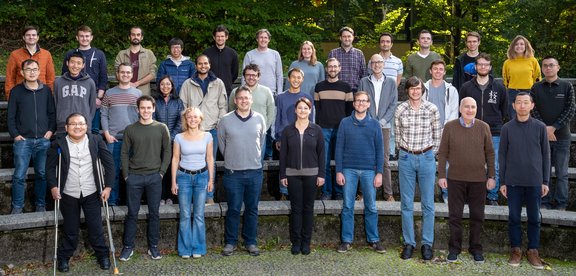
High-Energy Processes and Correlated Quantum DynamicsThe last two decades have witnessed an enormous and still ongoing progress in high-power laser technology. As a result, today it is possible to produce keV photons, MeV ions and GeV electrons by laser radiation, which lies beyond the typical energy scale of atomic physics. Against this background, we study highly energetic processes in atomic, nuclear and particle physics which take place in the presence of intense laser fields. We consider ultrafast, mostly relativistic collision processes in strong laser fields. These are either scattering reactions occuring inside a background laser wave, or collisions of particles with intense laser beams. The particles involved comprise electrons, positrons, muons, protons and heavy ions. The presence of the laser field can modify the field-free properties of scattering processes or, more interestingly, it can open additional exit channels of particle collisions which are otherwise forbidden kinematically. For the laser field represents a reservoir of energy and momentum which can be utilized upon photoabsorption. As a consequence, the laser-induced reactions proceed non-linearly via multiphoton absorption, with the number of participating photons ranging from just a few to several millions or even billions of photons. A particular focus lies on exotic atomic species, such as positronium or muonic atoms. These systems are suitable for certain applications due to a more favorable mass ratio between the atomic constituent particles. In positronium, the mass ratio is one, which allows for laser-driven electron-positron collisions at high energy and luminosity. The large muon mass is responsible for the compact size of muonic atoms and the corresponding importance of the properties of the binding nucleus which can dynamically be revealed by laser assistance. People:
Former Members:
Some recent and current projects:
Laser-induced photoemission of electrons and atoms
Figure 1: Snapshot after 500 fs of an initially localized and Gaussian-shaped electron wave-packet, which is driven by a relativistically strong laser field of 800 nm wavelength [1]. (Copyright 2007 by the Optical Society of America) A free electron wave packet evolves in a complicated way in a strong laser field, due to the electric and magnetic forces exerted by the laser field in combination with quantum mechanical wave-packet spreading (see Fig.1). On the other hand, an electron in a laser field can radiate photons via Thomson scattering of laser photons. In view of the highly non-dipole dynamics of the wave packet, where different portions experience different laser phases, the question arises whether interference occurs in the radiation emitted by different parts of a single-electron wave packet. This basic but surprisingly subtle problem is addressed in [2]. The main result is that in most cases there is no interference in the photoemission of a single electron. Only under special circumstances (for example when the initial wave packet consists of discrete momentum components and the laser field deviates from a plane wave), quantum interference appears in the radiation. Bound atomic electrons can be utilized for frequency up-conversion of an applied laser field. This non-linear phenomenon is called high-harmonic generation and based on laser-driven electron-ion recollisions: After field-ionization, the electron is accelerated by the laser field to high kinetic energies and afterwards driven back to the parent ion where it then recollides. In this collions, the electron can recombine with the ionic core and return its kinetic energy via photoemission at a harmonic frequency. The maximum recollision energy is proportional to the applied field intensity. At relativistic laser intensities, however, the conversion efficiency is largely suppressed by the influence of the laser magnetic field which presses the ionized electron into forward direction so that it misses the parent ion at the recollision moment. In the weakly relativistic regime, the magnetic drift can be compensated by assisting the process with a high-frequency attosecond pulse train which ionizes the atom and supplies the electron with a starting velocity in the desired direction. This way, coherent hard x-rays of up to 40 keV can be produced [3]. Nuclear effects in laser-driven muonic atoms
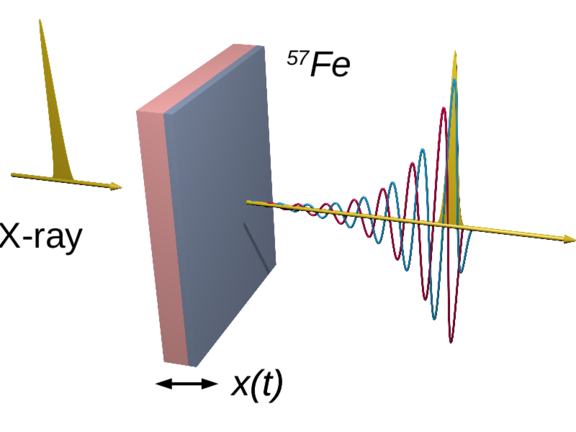
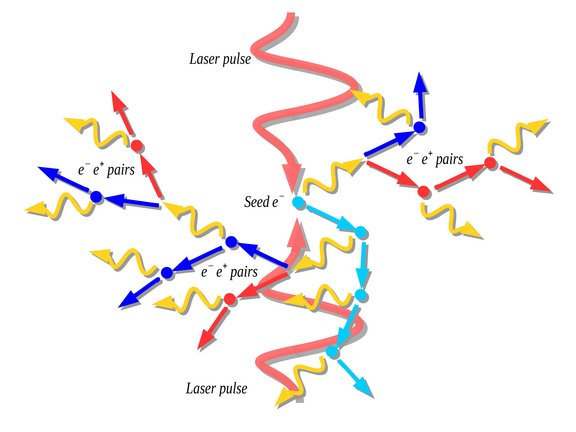
Figure 2: High-harmonic spectra for muonic hydrogen (black) versus muonic deuterium (red) in an intense VUV laser field. The harmonic signal from muonic hydrogen is enhanced due to the smaller radius of the binding nucleus [1]. (Copyright 2007 by the American Physical Society) Muonic atoms represent traditional tools for nuclear spectroscopy with atomic physics techniques which measure bound-bound transitions between stationary states. Due to the small Bohr radius of these systems, the muonic wave function has a large overlap with the nucleus and thus effectively probes its structural features. When a muonic atom is exposed to a strong laser field, the problem becomes explicitly time-dependent and the muon a dynamic nuclear probe. The radiative response of a laser-driven muonic atom via high-harmonic generation, for example, exhibits nuclear signatures resulting from the finite nuclear mass, size and shape [1,2]. The muon, which is periodically driven across the nucleus by the laser field, can also constitue a pump-probe scheme: In a first recollision, the muon excites the nucleus to a higher level and probes the excited state during a subsequent encounter. This way, information on excited nuclear levels could be obtained in a time-resolved manner. Laser-driven bound muon dynamics may also lead to nuclear excitation [3]. Electron-positron pair creation in laser fieldsIn the presence of very strong electromagnetic fields, the physical vacuum becomes unstable and decays into electron-positron pairs. As to pair production in intense laser fields, various regimes of interaction exist, ranging from the tunneling regime to the multiphoton regime (see, e.g., [1,2]). Analogous interaction regimes are known from strong-field ionization of atoms and molecules. A pioneering experiment on electron-positron pair creation in combined laser and Coulomb fields has been conducted at the Stanford Linear Accelerator Center (see D. Burke et al., Phys. Rev. Lett. 79, 1626 (1997)). In the experiment, an ultrarelativistic electron beam was brought into collision with an intense optical laser pulse and the pairs were produced in a two-step process via Compton scattering.
Figure 3: Sketch of the collision between a relativistic ion beam and an intense laser pulse, which leads to the production of an electron-positron pair via multiphoton absorption. The indirect production mechanism can be avoided when a heavy projectile like a nucleus is employed. Compton scattering is largely suppressed then and the direct channel of electron-positron pair creation becomes dominant. Pair production in combined laser and nuclear Coulomb fields has usually been calculated by employing the so-called Volkov solutions to the Dirac equation. For linearly polarized laser fields, however, this approach is very demanding numerically, so that most studies were restricted to the case of circular laser polarization. To overcome this problem, we have developed an alternative theoretical framework based on the exact polarization operator in the presence of an electromagnetic wave [3]. Within this approach, a closed expression for the total creation rate is obtained by analytical means for arbitrary laser polarization and various interaction regimes of interest. For an experimental realization of the process, intense attosecond pulse trains in conjunction with the LHC at CERN are particularly promising [4]. In laser-nucleus collisions bound-free pair production can also occur, where the electron is created in a bound state of the projectile ion. This process has been considered in the collision of an x-ray laser beam with a relativistic highly-charged ion within the few-photon regime [5,6]. Moreover, we have recently considered electron-positron pair creation in two counterpropagating laser beams, with a focus on the intermediate regime of interaction where we studied the influence of the laser magnetic field on the production process [7]. Particle physics with laser-driven high-energy collisions
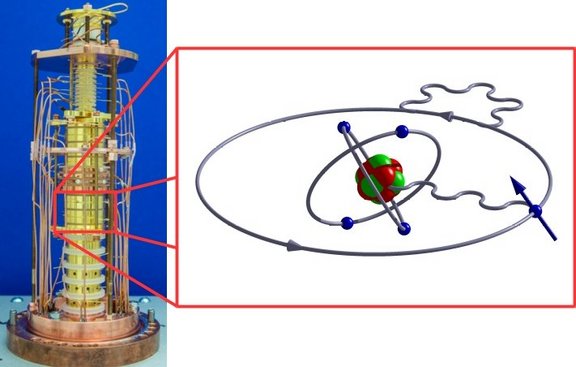
Figure 4: Snapshot of an electron wave packet, originating from a positronium atom and driven by counterpropagating, strong laser pulses into recollision with a corresponding positron wave packet. In such collisions, muon or pion pairs can be generated at high laser intensity. Inside the most powerful laser fields presently available, electrons are accelerated to energies in the GeV regime. Such high energies can pave the way to laser particle physics by virtue of laser-driven electron-electron or electron-positron collisions. An appealing way to realize the latter is to employ positronium atoms which are made of electrons and positrons. Positronium exhibits unique dynamical properties in a strong laser field due to the equal magnitude of their charge-to-mass ratios: After instantaneous ionization the leptons oscillate in opposite directions along the laser electric field, which leads to periodic electron-positron collisions since both particles experience an identical magnetic drift motion. These collisions are characterized by very small impact parameters because the collision partners stem from the same atom (where they are spatially confined to distances of the order of the Bohr radius) and are driven by the same laser field. The correspondingly large current densities lead to high collision luminosities [1]. As an example, we have calculated the production of a muon-antimuon pair from a laser-driven positronium atom [2-4]. Alternatively, muon pairs can also be produced in ultrarelativistic collisions of protons and heavy ions with x-ray laser beams. An interesting aspect of this process is its sensitivity to the nuclear form factor because of the small muonic Compton wavelength [5]. |