Determination of the g-Factor of the Proton
Motivation
Physicists are particularly studying quantities in a system or a process that are invariant against physical operations. The results of such experiments are symmetries, such as charge-conjugation (C), parity (P) or time inversion (T). These symmetries are coupled to properties of the corresponding mathematical formalisms. In 1954 Pauli formulated the so called CPT-theorem, which postulates the general invariance under simultaneous reversal of charge, parity, and time. This constitutes one of the most fundamental theorems of physics. Since then physicists are trying to achieve a complete experimental verification of this theorem.
The magnetic dipole moment of a particle is a characteristic measured quantity which is experimentally accessible and can be measured with high precision. Described by the so called "g-factor", this quantity should yield the same value for matter as well as antimatter according to the CPT theorem. We intend to perform a high-precision measurement of the g-factor of the proton and its antiparticle, the antiproton, in order to carry out a stringent test of this theorem.
Furthermore, this experiment will be the first direct measurement of the proton g-factor since it has not yet been experimentally determined. The present value is derived from measurements of the hyperfine structure in hydrogen.
Introduction
The g-factor - also called Landé factor - describes the ratio of the magnetic moment μ of a particle and the total angular momentum J: μ = - gj (e/2me) J. J is the result of the vectorial composition of orbital angular momentum and spin: J = L + S (Figure 1).
Figure 1: Coupling of the vectors of spin S and orbital angular momentum L to the total angular momentum J according to the vector model. The vectors S and L show a precessional motion around vector J.
In our experiment we analyse the spin motion. In the case of a proton we have S = ½ and the corresponding magnetic moment is denoted by μS. In an external magnetic field B the spin can take on but two discrete orientations out of quantum mechanical reasons, namely parallel or antiparallel to the direction of B (Figure 2).
Figure 2: The spin of a spin ½ particle and thus the magnetic moment have two potential orientations in an external magnetic field. The external magnetic field has the strength B0 in z-direction. Here, gs is the g-factor and μB denotes the Bohr magneton.
These two states correspond to a Zeeman splitting with an energy hωL, where ωL is just the classical Larmor precession frequency of a magnetic dipole. Determining this frequency the g-factor gS can be extracted from the relation above.
Measurement Principle
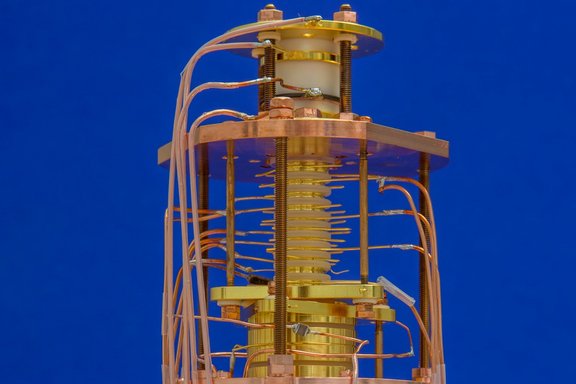
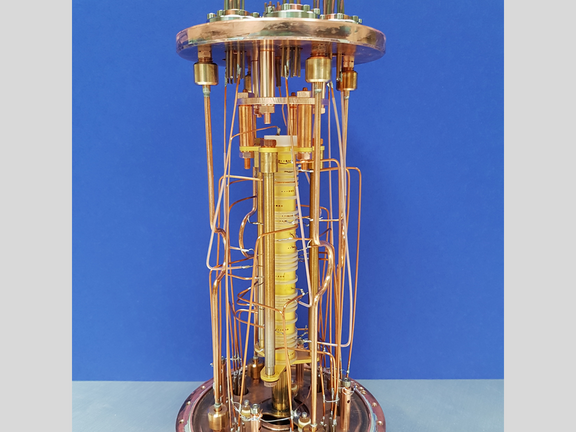
Electrically charged particles can be stored contact-free in a Penning trap by a combination of a weak electrostatic and a strong homogeneous magnetic field. To this end we use a Penning trap system (Figure 3).
detection electronics. To the right, a schematic illustration of a Penning
trap is shown with the electronic detection system. Electrically charged
particles can be stored in one of the traps and transported to the other
trap. Larmor and cyclotron frequency are detected by oscillation circuits.
- click for bigger version -
By means of suitable electronic detection methods both the detection of the trapped particles and the reduction of their kinetic energy (cooling) down to values less than one milli electron volt are possible. Such cooled and almost completely motionless particles in a well defined high precise storage field are very suitable experimental objects to show fundamental properties with high accuracy.
The measurement will be performed on a single proton stored in a cryogenic Penning trap - the precision trap. The proton exhibits an orbital motion because of the presence of the magnetic field, the so called cyclotron motion. This frequency of motion ωc can be detected nondestructively by means of induced image charges and highly sensitive, partly superconductive detection electronics (see also Figure 3). In a following step the Larmor frequency is determined. To this end the spin of the proton has to be flipped by a suitable high frequency field (M1 transition). Plotting the probability rate of successful spin flip vs. the frequency of the excitation field, the maximum of the spin flip rate (subject to certain corrections of the curve form) represents the Larmor frequency ωL. The experimentally determined Larmor and cyclotron frequency yield the g-factor gs and thus the magnetic moment according to the simple relation: gs = 2 (ωL/ωc).
The nondestructive detection of the spin flip represents an experimental challenge. Similar to the previous experiments on a free electron or on a single hydrogen-like carbon ion or oxygen ion (12C 5+, 16O 7+), the continuous Stern-Gerlach effect is utilized. In this case, a second ion trap - the analysis trap is used additionally to the actual precision trap described above in which the spin flip is induced. The analysis trap contains a well defined inhomogeneity of the magnetic field causing the coupling of the spin direction to the motional frequencies of the proton. The spin flip can be observed in the form of quantum leaps exploiting the extremely accurate determination of the motional frequencies of the stored proton.
Experimental Setup
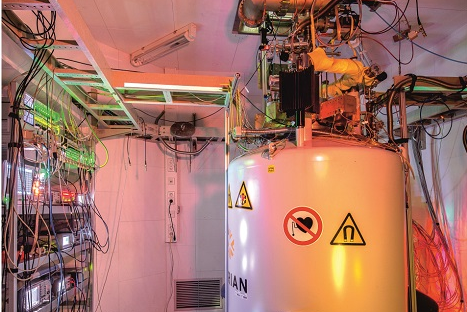
Figure 4 shows the experimental setup. In order to perform the experiment, the Penning trap system is put into a superconducting magnet. The devices, which are needed for cooling the Penning traps, are placed on a mobile mount in order to be able to easily move the Penning trap system.
Status
Taking into account the experimental techniques used for the measurement of the electronic g-Faktor of 16O 7+ and 12C 5+, preliminary considerations for the experiment with a single proton were made. Theoretical simulations concerning suitable trap geometries and an improved trap design for the novel apparatus have been performed and are almost completed. At present technical drawings are created, which will serve as foundation for the construction of a suitable cryogenic vacuum device as well as the actual ion trap.
References
- W. Quint et al.: Continuous Stern-Gerlach effect and the magnetic moment of the antiproton, Nuclear Instruments and Methods in Physics Research B 214 (2004) 207-210
- G. Werth et al.: Continuous Stern-Gerlach effect on atomic ions, Advances in Atomic, Molecular, and Optical Physics 48 (2002), 191-217
- L. Brown et al.: Geonium theory: Physics of a single electron or ion in a Penning trap, Reviews of Modern Physics 58 (1986), 233 - 311